
Flatbed vs. Wheel-Lift Towing: Which Option Is Best in Honolulu?
Introduction

When your vehicle breaks down or needs to be transported, choosing the right towing method is crucial. Honolulu’s unique mix of tight urban streets, steep hills, and busy highways means not all towing methods are equally effective—or equally safe. The two most common options are flatbed towing and wheel-lift towing, and understanding the difference can help you make the right decision when you’re stuck roadside.
In this guide, we break down flatbed vs wheel lift towing, explain which vehicles each method suits, compare safety levels, and clarify why one option is often better for long-distance or specialty transport.
What’s the Difference Between Flatbed and Wheel-Lift Towing?
Both towing methods are widely used across Honolulu, but they work very differently.
Flatbed Towing
A flatbed truck uses a long, level platform to carry the entire vehicle off the ground.
The bed tilts downward to create a ramp, and the vehicle is either driven or winched onto it.
All four wheels are fully secured and lifted off the roadway.
Best for:
AWD/4WD vehicles, luxury cars, trucks, low-clearance vehicles, accident-damaged cars, long-distance towing.
Wheel-Lift Towing
A wheel-lift tow truck uses a hydraulic yoke that lifts either the front or rear wheels off the ground.
The remaining two wheels stay on the road and roll during transport.
It’s quicker and ideal for tight city spaces.
Best for:
Short-distance towing, compact cars, parking violations, and situations where vehicle access is limited.
Which Vehicles Are Best Suited for Each Method?
Honolulu sees everything from lifted trucks in Kapolei to sports cars in Waikiki. Here’s how to choose the right towing method based on your vehicle type:
Flatbed Towing Is Recommended For:
AWD & 4WD Cars and SUVs
Flatbed towing keeps all four wheels off the ground, preventing drivetrain strain or transmission failure. AWD systems can be damaged if towed incorrectly, making a flatbed the safest, manufacturer-approved option.
Luxury and Exotic Vehicles
High-end vehicles have sensitive components and low profiles that need extra care. A flatbed prevents scraping, alignment issues, and road debris damage by keeping the vehicle fully lifted and level.
Low-Clearance Vehicles
Sports cars and lowered imports can scrape easily when wheel-lifted. Flatbed towing uses a smooth, angled ramp that avoids bumper or undercarriage contact, ensuring damage-free transport.
Classic and Collector Cars
Older and collector vehicles benefit from the stability and gentle handling of a flatbed. It minimizes vibration, avoids unnecessary wear, and protects delicate components during transport.
Heavily Damaged or Non-Drivable Vehicles
Cars involved in accidents or unable to roll safely must be fully lifted. Flatbed towing loads the vehicle securely without adding stress, preventing further damage during transport.
Wheel-Lift Towing Works Best For:
Lightweight Sedans and Compact Cars
Smaller vehicles can be safely moved short distances with wheel-lift towing. It’s quick to deploy, efficient, and ideal for simple breakdowns where fast service is needed.
Tight Parking Lots and Garages
Wheel-lift trucks can access tight Honolulu parking structures and narrow stalls that flatbeds can’t reach. Their compact size makes them perfect for urban towing situations.
Cars Blocked In or Parked at Difficult Angles
When a vehicle is boxed in or parked awkwardly, wheel-lift towing allows precise access. The hydraulic arms slide under the wheels with minimal space, making it ideal for crowded or restricted areas.
While wheel-lift towing is perfectly safe for many vehicle types, it’s not always the best choice—especially for high-value, AWD, or sensitive vehicles.
Safety Comparison: Flatbed vs. Wheel-Lift Towing
Safety is one of the biggest factors Honolulu drivers consider when choosing a towing method.
Safety Advantages of Flatbed Towing
Flatbed towing is widely considered the safest towing option. Here’s why:
The entire vehicle stays lifted off the ground.
No risk of bumper drag or undercarriage scraping.
Reduced strain on tires, suspension, and drivetrain.
Minimal chance of road debris damage.
More stable during sudden stops or sharp turns.
This is especially important on the H-1, H-2, and H-3, where sudden braking and sharp curves are common.
Safety Advantages of Wheel-Lift Towing
Wheel-lift towing is safe when performed correctly and for the right vehicle type:
Hydraulically controlled lift arms reduce frame contact.
Good for short, local trips.
Less risk than outdated hook-and-chain towing.
However, it can expose your vehicle to additional wear, especially on long-distance trips or uneven terrain.
When Wheel-Lift Towing Isn’t Ideal
Avoid wheel-lift towing if your vehicle is:
AWD/4WD
Severely damaged
Low to the ground
A luxury/high-end model
In these cases, flatbed towing is the smarter and safer choice.
Why Flatbed Towing Is Preferred for Long Distances & Special Vehicles
Honolulu drivers often need to transport vehicles across Oahu—from Kapolei to Pearl City, Honolulu to Kāneʻohe, or even across town. In these situations, flatbed towing stands out as the superior method.
1. Zero Wear on Your Vehicle
Long-distance towing with a wheel-lift can:
Wear tires unevenly
Stress the drivetrain
Increase suspension strain
Flatbed towing eliminates these problems by lifting the vehicle completely.
2. Better Stability on Highways
Island highways often involve steep inclines, crosswinds, and sudden lane changes. A flatbed provides unmatched stability throughout the trip.
3. Ideal for High-Value Vehicles
Honolulu has many Teslas, BMWs, Mercedes, classic imports, and collector cars—flatbed towing is the only method that guarantees:
Zero dragging
No scratches or body damage
Level, gentle transport
4. Recommended by Manufacturers
Many vehicle manufacturers specifically require flatbed towing for:
AWD vehicles
Most electric vehicles
Hybrid sedans
Luxury performance cars
Ignoring manufacturer guidelines can void your warranty or damage the drivetrain.
5. Safer Loading for Damaged or Non-Rolling Vehicles
If your vehicle is:
Involved in an accident
Stuck in park
Missing wheels
Locked up
Flatbed towing is typically the only safe solution.
Flatbed vs Wheel-Lift Towing: Which Should You Choose?
Here’s a quick comparison to help you decide:
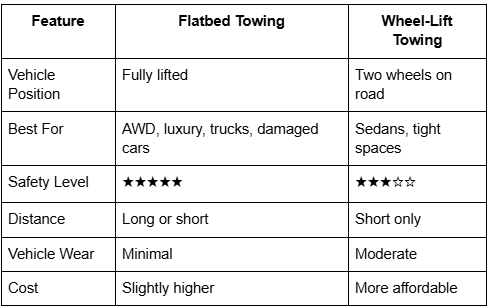
In Honolulu, flatbed towing is usually the better—and safer—choice, especially considering the terrain, traffic, and diverse vehicle types on the island.
Wheel-lift towing remains a strong option for quick, short-distance jobs or when maneuvering in tight urban spaces.
Need Help Choosing the Right Towing Method?
At Discount Towing in Honolulu, we understand that every vehicle and situation is unique. Our experienced team will guide you to the safest, most efficient towing method based on your location, vehicle type, and circumstances.
Contact us for expert towing recommendations. Whether you need flatbed towing, wheel-lift towing, or roadside assistance anywhere on Oahu, we're here 24/7 to help.