
Lowboy vs Landoll Trailer: What’s the Difference (and Which One Do You Need)?
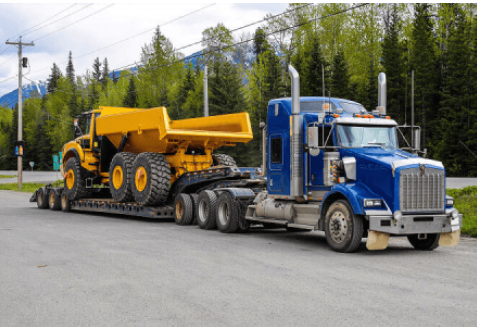
When transporting heavy or oversized loads, choosing the right trailer is just as important as choosing the right truck. Two of the most commonly used trailers for heavy hauling and container transport are lowboy trailers and Landoll trailers. While they may look similar at first glance, they are designed for different purposes and perform differently depending on the type of load and site conditions.
Understanding the differences between lowboy and Landoll trailers can help you determine which option is best for your specific transport needs. This guide explains how each trailer works, what types of loads they are best suited for, and how to choose the right one for your project.
What Is a Lowboy Trailer?
A lowboy trailer, also known as a lowbed trailer, is designed to carry tall and heavy loads while keeping the overall height as low as possible. The trailer deck sits close to the ground, allowing oversized equipment to be transported without exceeding height restrictions.
Lowboy trailers typically feature either a fixed gooseneck or a removable gooseneck, which allows equipment to be driven or loaded onto the deck from the front.
Common Uses of Lowboy Trailers
Lowboy trailers are commonly used to transport:
Construction equipment such as excavators and bulldozers.
Large machinery.
Industrial equipment.
Oversized loads with height restrictions.
Their low deck height makes them ideal for moving tall equipment through areas with bridges, overpasses, or overhead clearance limitations.
What Is a Landoll Trailer?
A Landoll trailer, also known as a traveling axle trailer, is a specialized heavy-haul trailer with a hydraulic tilting deck. The deck can be lowered to the ground by shifting the axle position, allowing loads to be winched or driven onto the trailer without the need for cranes.
Landoll trailers are particularly well-suited for transporting heavy, rigid loads that cannot be easily lifted.
Common Uses of Landoll Trailers
Landoll trailers are often used for:
Heavy machinery.
Large industrial components.
Loads requiring ground-level loading.
The tilting deck provides flexibility in loading and unloading, especially at sites without lifting equipment.
Key Structural Differences
The primary structural difference between lowboy and Landoll trailers lies in how they load and support cargo.
Lowboy trailers have a fixed low deck designed to keep loads under height limits. They rely on ramps or removable goosenecks for loading. Once loaded, the deck remains static.
Landoll trailers use a hydraulic system that allows the deck to tilt and lower to the ground. The axle moves forward or backward to adjust the deck angle, making it easier to load heavy loads without lifting.
These design differences influence how each trailer performs in real-world transport situations.
Loading and Unloading Methods
Loading and unloading methods are a major point of difference between these two trailer types.
Lowboy trailers typically require:
Ramps.
Front-loading via removable gooseneck.
Cranes or forklifts for certain loads.
Landoll trailers allow:
Ground-level loading.
Winching heavy loads onto the deck.
Reduced reliance on external lifting equipment.
This makes Landoll trailers especially useful for sites with limited equipment or restricted access.
Weight Capacity and Load Stability
Both lowboy and Landoll trailers are designed for heavy loads, but they distribute weight differently.
Lowboy trailers are ideal for very heavy equipment that needs a stable, low center of gravity during transport. Their design provides excellent stability for tall loads.
Landoll trailers are designed to handle heavy loads while also supporting the hydraulic tilting mechanism. While stable, they may require additional space and careful operation during loading and unloading.
Understanding load weight and balance is critical when selecting between these trailers.
Access and Site Condition Considerations
Site conditions play a major role in trailer selection.
Lowboy trailers require enough space for ramps or front loading. They work best in open areas where loading equipment is available.
Landoll trailers require space for the deck to tilt and the axle to travel. Uneven or soft ground may limit their use, as stability is essential during loading.
Evaluating access points, ground conditions, and available equipment helps determine which trailer is more practical.
Permit and Regulatory Factors
Both lowboy and Landoll trailers may require permits depending on load size, weight, and route. However, the type of trailer used can influence permit requirements.
Lowboy trailers help reduce overall load height, which can simplify permitting for tall equipment. Landoll trailers may result in slightly higher overall height but offer flexibility in loading.
Understanding local regulations and route restrictions is essential for compliance.
Cost and Operational Differences
Cost differences between lowboy and Landoll trailers depend on several factors, including equipment availability, labor requirements, and project complexity.
Lowboy trailers are often more cost-effective for straightforward equipment transport when loading equipment is available.
Landoll trailers may cost more due to their specialized hydraulic systems but can reduce labor costs by eliminating the need for cranes or forklifts.
Choosing the right trailer can help balance upfront costs with operational efficiency.
Which Trailer Do You Need?
Choosing between a lowboy and a Landoll trailer depends on your specific needs.
A lowboy trailer may be the better choice if:
The load is tall and requires low transport height.
Loading equipment is available.
The site has sufficient space for ramps or front loading.
A Landoll trailer may be the better option if:
The load is extremely heavy or rigid.
Ground-level loading is required.
The site lacks cranes or forklifts.
Planning Ahead for the Right Choice
Proper planning ensures the correct trailer is selected for the job. This includes evaluating load dimensions, weight, site access, and regulatory requirements.
Early planning helps avoid delays, unexpected costs, and safety issues. Matching the trailer to the project’s needs leads to smoother operations and safer transport.
Conclusion
Lowboy and Landoll trailers are both essential tools in heavy hauling, but they serve different purposes. Lowboy trailers excel at transporting tall equipment while maintaining low overall height, making them ideal for navigating clearance restrictions. Landoll trailers offer unmatched flexibility in loading heavy and rigid loads, especially when lifting equipment is unavailable.
Understanding the differences between these trailers allows you to choose the right option for your transport needs. By considering load characteristics, site conditions, and operational requirements, you can ensure safer, more efficient, and more cost-effective heavy hauling operations.